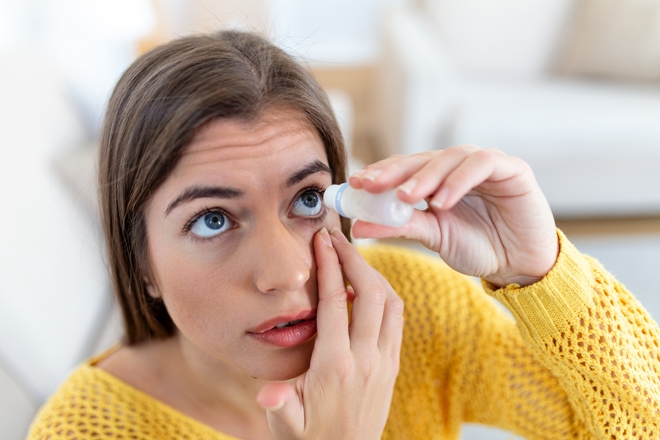
Photo Credit: by stefamerpik, magnific.com
You put in another eye drop. For a little while, your eyes feel better. Then the burning, grittiness, irritation, or blurry vision comes creeping back.
So, you reach for the bottle again.
If this is you, you are not alone. Artificial tears can be extremely helpful for dry eye, but persistent symptoms may mean the problem is not simply that your eyes are failing to produce enough watery tears. In some people, tears are produced but disappear from the eye's surface too quickly.
The eye can’t hang onto the moisture.
This is known as evaporative dry eye, and meibomian gland dysfunction (MGD) is an important cause. The meibomian glands supply oils to the tear film that help keep tears from evaporating too quickly. When that protective layer does not work properly, repeatedly adding more moisture may provide only temporary relief.
Read on to understand what your eyes are craving and whether you need a prescription to get it.
What Is Evaporative Dry Eye?
The tear film coating the eye is not simply water.
Meibomian glands located along the eyelids secrete an oily substance called meibum. This lipid component spreads across the tear film and helps prevent the tear film's watery (aqueous) portion from evaporating too rapidly.
When those glands become obstructed, or their secretions become abnormal, the tear film can become unstable.
Moisture may then disappear from the surface of the eye more quickly, contributing to dryness, irritation, burning, fluctuating vision, and other dry eye symptoms.
Meibomian gland dysfunction appears to be extremely common among people with dry eye disease. In a clinic-based study of dry eye patients, researchers evaluated 224 people classified as having dry eye disease. Of the 159 patients who could be classified into aqueous-deficient, MGD-associated, or mixed dry eye, around half had MGD without aqueous deficiency, 14% had aqueous deficiency without MGD, and 36% showed evidence of both. This means that overall, 86% of these 159 patients showed signs of MGD.
Those numbers help explain why treating dry eye can be frustrating: one person may need over-the-counter (OTC) lubrication for aqueous deficiency alone; another may need treatment aimed at evaporation; another may have significant inflammation; and many others may have more than one problem at the same time.
The Screen-Stare Effect: Why Blinking Matters
Modern screen use may make an unstable tear film even more troublesome.
Blinking is not just something your eyelids do automatically. A complete blink helps spread tears and meibomian gland secretions across the eye. During concentrated computer work, however, people can blink less frequently or incompletely.
One study involving 30 people with dry eye found an average blink rate of 16.8 blinks per minute during conversation, compared with only 6.6 blinks per minute during initial computer use. After 30 minutes of computer work, the average remained low at 5.9 blinks per minute. That’s a pretty significant decrease in blinking – a function your eyes need to work properly.
This does not mean screens are the cause of every case of dry eye. But less frequent or incomplete blinking can leave the tear film exposed for longer periods, potentially making evaporation more noticeable in someone whose tear film is already unstable.
Why Artificial Tears May Not Be Enough
Artificial tears remain an important treatment for dry eye, and it would be incorrect to suggest that all OTC eye drops merely “add water.”
Artificial tears come in many formulations. Some contain ingredients designed primarily to lubricate the eye, while others contain lipid components intended to support the tear film's oily layer.
However, if excessive evaporation is a major part of your dry eye disease, adding fluid may not fully address why that moisture keeps disappearing.
That has led researchers to investigate another approach: creating a physical barrier that slows evaporation itself.
Miebo: A Water-Free Approach to Dry Eye
The dry eye drops perfluorohexyloctane ophthalmic solution (Miebo) received its initial U.S. approval in 2023.
According to the current Food and Drug Administration (FDA)’s prescribing information for Miebo, it is indicated for the treatment of the signs and symptoms of dry eye disease. It is a waterless formula.
According to the labeling, perfluorohexyloctane forms a monolayer at the air-liquid interface of the tear film, which is thought to reduce evaporation.
In other words, instead of primarily attempting to replace lost tear fluid, Miebo is intended to help keep moisture from escaping as quickly.
How Effective Is Miebo for Dry Eye?
Perfluorohexyloctane ophthalmic solution was evaluated in two large phase 3 randomized clinical trials, GOBI and MOJAVE. Both enrolled adults with dry eye disease and signs of meibomian gland dysfunction, and both trials showed significant benefit over saline (a salt-water solution). By week eight, more than 61% of people receiving the medication showed improvements in dry eye, and some found benefit after only two weeks.
So, it’s important to note that while the perfluorohexyloctane ophthalmic solution did help most people, it didn’t help everyone.
How to Use Miebo Correctly
The current FDA prescribing information recommends one drop into each affected eye four times daily.
But don’t forget, contact lenses must be removed before Miebo is used. You should leave your lenses out for at least 30 minutes after administering the drops.
If you use several eye medications, ask your pharmacist or doctor how they should be ordered and spaced.
According to the current FDA labeling, a small number of people experience blurred vision or red eyes when administering drops; however, the effects are generally mild and transient. If you experience any concerning side effects, make sure to contact your pharmacist or doctor.
What If Evaporation Isn't Your Only Dry Eye Problem?
Perfluorohexyloctane ophthalmic solution is one prescription option, but dry eye disease has multiple possible causes. If inflammation, impaired tear production, or another process is contributing to symptoms, a doctor may recommend a different medication—or combine approaches.
Cyclosporine Drops Restasis, Cequa, and Vevye Target Inflammation
You may need to take a treatment that works on the inflammatory processes in the eye. There are several eye drop options that all involve cyclosporine.
• Cyclosporine 0.05% (Restasis) is used twice daily. Its current prescribing information states that it increases tear production when tear production is presumed to be suppressed by ocular inflammation associated with dry eye syndrome.
• Cyclosporine 0.09% (Cequa) is also used twice daily. Its current prescribing information states that it is a calcineurin inhibitor immunosuppressant that increases tear production, which is associated with dry eye disease.
• Cyclosporine 0.1% (Vevye) takes another water-free approach. According to its FDA prescribing information, Vevye is used twice daily. Again, it is indicated for the signs and symptoms of dry eye disease.
Each of the above three medications has clinical data supporting it. Your doctor will choose the strength that is right for you and your symptoms.
Other Medications That May Help Dry Eye Disease
If the above three medications don’t help, there are additional medications that are unique in their own ways.
• Lifitegrast 5% (Xiidra) is another anti-inflammatory prescription eye drop for dry eye disease; however, according to the labeling, it inhibits the interaction between lymphocyte function-associated antigen-1 (LFA-1) and ICAM-1, which is involved in T-cell-mediated inflammation. It is also used twice a day.
• Varenicline solution (Tyrvaya): This option is unique because it isn’t an eye drop—it is a nasal spray. This is probably why sneezing is so common upon application. According to the prescribing information, the medication is sprayed once per nostril, twice a day.
Alrex; Eysuvis: Short-Term Help for Dry Eye Flares
Loteprednol etabonate 0.25% (Alrex; Eysuvis) is different again. It is an ophthalmic corticosteroid intended for short-term treatment rather than for continuous dry eye maintenance, as in the above.
The medication prescribing information specifies treatment of the signs and symptoms of dry eye disease for up to two weeks, usually at a dose of one to two drops in each eye four times daily.
Like with other steroids, this medication is usually used for a short time. In this case, prolonged ophthalmic corticosteroid use can raise intraocular pressure and increase other ocular risks, so treatment should be renewed only after an appropriate eye examination and assessment.
The Question to Ask If Your Dry Eye Drops Keep Failing
If you seem to be putting artificial tears in constantly only to have your symptoms quickly return, you may need to ask your doctor a certain question.
Instead of simply asking, “How can I add more moisture?”, ask your optometrist or ophthalmologist:
“Could excessive evaporation or (meibomian) gland dysfunction be contributing to my dry eye?”
It’s a bit more complicated, sure, but it may be what’s at the bottom of your dry eye.
An eye-care professional can evaluate tear production, tear-film stability, the ocular surface, eyelid and meibomian gland function, and other possible contributors to your symptoms.
For some patients, an evaporation-focused treatment may make sense. Others may need treatment directed toward inflammation, tear production, meibomian gland dysfunction, environmental factors, or several of these at once.
The key is recognizing that dry eye does not always mean there isn't enough moisture being produced.
Sometimes the problem is that your eyes can't hold on to it.
Sources
1. Bausch & Lomb Incorporated. (2023). Highlight of Prescribing Information. https://www.accessdata.fda.gov/drugsatfda_docs/label/2025/216675s009lbl.pdf
2. Cequa - Cyclosporine Solution/Drops. (2026, June 15). DailyMed. Retrieved August 27, 2026, from https://dailymed.nlm.nih.gov/dailymed/drugInfo.cfm?setid=48c3d8a3-4289-4b52-9189-58b48596095c
3. Eysuvis - Loteprednol Etabonate Suspension/Drops. (2025, March 11). DailyMed. Retrieved August 28, 2026, from https://dailymed.nlm.nih.gov/dailymed/drugInfo.cfm?setid=a2169d82-4275-4ab6-a1c3-c274080b815c
4. Fahmy, A. M., Harthan, J. S., Evans, D. G. et al. (2024). Perfluorohexyloctane ophthalmic solution for dry eye disease: pooled analysis of two phase 3 clinical trials. Frontiers in Ophthalmology, 4, 1452422. https://doi.org/10.3389/fopht.2024.1452422
5. Lemp, M. A., Crews, L. A., Bron, A. J. et al. (2012). Distribution of Aqueous-Deficient and Evaporative Dry Eye in a Clinic-Based Patient Cohort. Cornea, 31(5), 472–478. https://doi.org/10.1097/ico.0b013e318225415a
6. Restasis Multidose - Cyclosporine Emulsion. (2025, August 21). DailyMed. Retrieved August 27, 2026, from https://dailymed.nlm.nih.gov/dailymed/drugInfo.cfm?setid=7224d810-bb96-4682-a942-3355e6e8061a
7. Sambhara, D., March De Ribot, F., Barash, A. et al. (2025, December 10). Meibomian Gland Dysfunction (MGD). EyeWiki. Retrieved August 28, 2026, from https://eyewiki.aao.org/Meibomian_Gland_Dysfunction_%28MGD%29
8. Schlote, T., Kadner, G., & Freudenthaler, N. (2004). Marked reduction and distinct patterns of eye blinking in patients with moderately dry eyes during video display terminal use. Graefe S Archive for Clinical and Experimental Ophthalmology, 242(4), 306–312. https://doi.org/10.1007/s00417-003-0845-z
9. Tyraya - Varenicline Spray. (2026, July 15). DailyMed. Retrieved August 28, 2026, from https://dailymed.nlm.nih.gov/dailymed/drugInfo.cfm?setid=014c93dc-5737-479c-a9f0-aaadac1ac298
10. Vevye - Cyclosporine Ophthalmic Solution/Drops. (2026, February 26). DailyMed. Retrieved August 27, 2026, from https://dailymed.nlm.nih.gov/dailymed/drugInfo.cfm?setid=0a60fccf-7e1b-44fe-e063-6394a90aadd5
###
Your email address will not be published. Required fields are marked with *.